Table of Contents
- Item 1
April 16, 2026

.png)
.jpg)
Table of Contents
6
min read
Many Shopify Plus teams end up using bundles as a pricing lever: add a bundle, add a discount, watch AOV rise.
That move usually buys the wrong kind of growth: shoppers learn to wait for promos, and your team drowns in SKU noise.
If you want bundles to lift order composition without becoming a discount habit, you need one constraint: start where intent is already doing the work.
From there, the only question that matters is whether your chosen surface can absorb a bigger basket without adding purchase risk, because the moment bundling introduces doubt, it stops being an AOV strategy and becomes a conversion tax.
Myth: bundles work because the discount persuades.
Reality: bundles work when they make a high-intent buying path feel more complete, more obvious, and less cognitively expensive.
That’s why the spine is simple: bundle only where intent is already high; bundling is an order-shaping tool, not a catalog-wide discount layer.
If that sounds too conservative, good. Conservative is what keeps the margin intact while you learn what actually moved the cart.
Instead of asking, ‘Should we bundle?’, ask: ‘Where is the shopper already one good nudge away from buying more?
When teams roll bundling across everything, it fails in predictable ways:
Here are the telltale signals your surface area is too wide:
Myth: more bundle coverage equals more revenue coverage.
Reality: more coverage often equals more noise, more discounting, and less clarity.
So the operator's move is to narrow the surface area until the data gets loud. The next question is what high intent actually looks like when you’re choosing that narrow starting point.
High-intent bundling shows up as a pattern in what shoppers do. You can see it in their clicks, comparisons, and add-to-cart behavior, and in whether they naturally build multi-item orders without extra persuasion.
Look for surfaces where:
Think of them as selection filters: the constraint that keeps bundling clean.
Pass the filters, and bundling becomes order-shaping. Fail them, and bundling becomes discounting with extra UI. In practice, the same pattern shows up repeatedly: the most profitable bundle wins usually come from narrowing to fewer surfaces where the shopper is already close to buying more, then making that next step easier, clearer, and safer.
They treat bundling as a merchandising + UX + systems problem, not a widget problem. This is also how we run ongoing Shopify optimization: diagnose high‑intent surfaces, ship changes, and protect conversion while AOV grows.
Better baskets come from guided decision design, not just offering visibility.
A few decision rules that keep bundles in order-shaping territory:
That’s the theory. This idea has to survive real shopping behavior. It should still work when shoppers edit the cart, change quantities, and take the fastest path to checkout because that’s where bundle UX either holds up or collapses into friction.
Even in categories where multi-item orders should feel natural, shoppers add more when the next item feels like a completeness move and when the experience doesn’t introduce uncertainty as the basket grows.
The team treated basket expansion as two problems at the same time: merchandising and cart reliability.
That matters because every extra item is another moment where the cart can wobble, and shoppers don’t blame edge cases, they blame the brand.
Instead of spreading bundles across the store, LaceLab implemented bundle offers on high-intent products using mix & match or builder-style bundles.
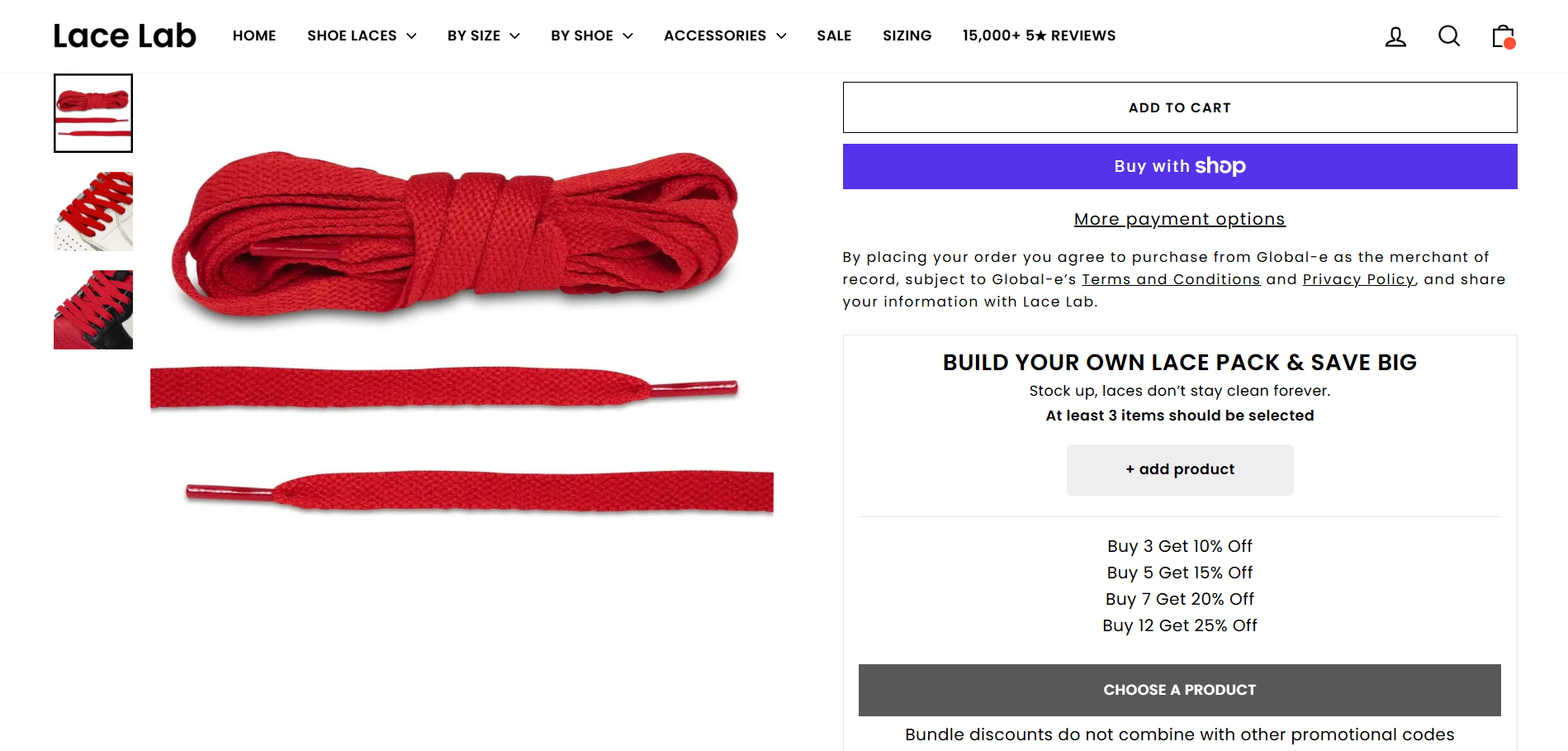
This is restraint: choosing the surfaces where intent and completeness already exist, so the bundle can guide instead of beg.
So what changed when bundling stopped being coverage and became a controlled order-shaping bet?
The tempting wrong move is to go wide: bundle everything, decorate the store with offers, and hope shoppers self-select into higher baskets.
What was done instead was bundle on high-intent products and stabilize the cart experience so the bigger basket didn’t introduce new failure points.
The measurable delta showed up where it counts:
Mechanism (why it worked): when bundles are anchored to high-intent products, the job is mainly guidance, helping shoppers complete the order with less effort and doubt. Mix & match / builder-style bundling shifts the default from one item and done to assembling a fuller order, while a stabilized cart keeps that assembly from collapsing into friction.
Operator implication (what this protects against): bundling lifts AOV and stress-testing the funnel at the same time.
If the cart can’t handle edits, redraws, and multi-item complexity without introducing uncertainty, your AOV play becomes a conversion tax.
If you’re treating bundles as an order-shaping system, the next step is not more bundles.
It’s identifying the few surfaces where attach can grow without creating friction, discount dependence, or cart instability.
Download the Cross-Sell Audit Playbook to find your first three decision points where multi-item intent already exists, and what’s currently blocking attach.

In 2010, Andrey founded MakeBeCool initially as a website development agency, but a discovery of the e-commerce world led to a complete retraining. With a newfound passion, he started collecting brand stories and case studies to empower e-commerce success. Beyond work, Andrey is a Lego Technic collector, a passionate snowboarder, runner, and fitness enthusiast. His active lifestyle extends to family time, where he shares his hobbies with his daughters.
View Author's PageOur Shopify Consultant will help you determine the ways of increasing professional growth
%20copy.webp)


